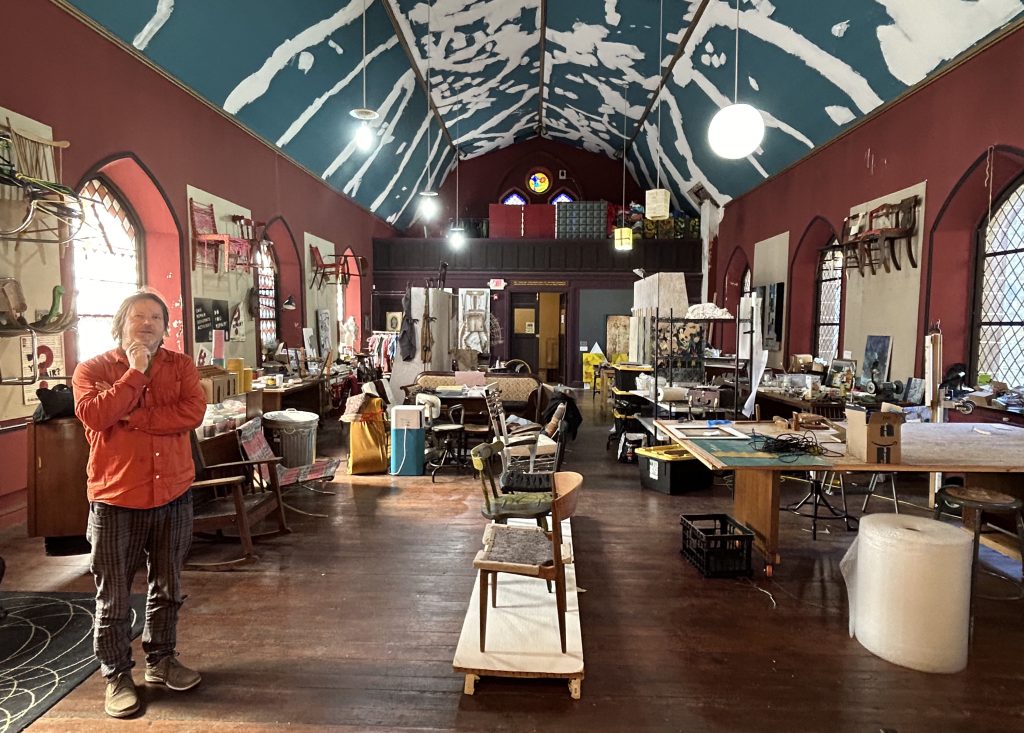
“Come in.” I heard the voice before I saw the man. I poked my head through a slightly open door on Church Street, followed the voice, and emerged into this cavernous space full of chairs. What I couldn’t figure out was whether the chairs were being taken apart or put back together. Of course artists can be found beavering away behind most doors around Providence, but this studio is something else. Meet Markus Berger and welcome to The Repair Atelier.
Berger is an artist, designer, writer, and researcher, and teaches at RISD in the Interior Architecture Department. And he is the founder and director of The Repair Atelier. From his book of the same name, “Founded in 2019, The Repair Atelier is a physical and conceptual space where the intersection of art, design, and (adaptive) reuse sparks innovation.”
He is currently planning a gallery event in the spring. We’ll keep you posted.
Side note: Soon after arriving, I began recording our conversation, but it hasn’t been easy sorting it all out. Berger has a charming Austrian accent (think Christoph Waltz) but we got into a lively conversation as we walked about and I kept seeing new things and interrupting with questions. So we had a grand old time, but transcribing the meeting has been a challenge. What I left with is not quite an interview. But I do know my chairs . . . and I asked about that. Professor Berger explained why he uses these common objects to help convey his larger message:
My chairs are an example of a circular economy. They are all somehow cast away, they are broken or not liked any more. They are all thrown away and what I do is pick them up and figure out how to transform them into something new. Most of them . . . it’s a chair again (laughs) . . but with total different aesthetic and also total different value . . . so basically showing that something that was considered as trash can have another life and can have another long life.
Check out these transformed chairs.
For Berger, who is also a registered architect in the Netherlands, this philosophy can be applied to the larger problem of new construction and industrial waste.
A colleague of mine from industrial design and myself, as part of a larger research project, we are kind of mapping out industrial waste in Rhode Island and connecting architects with a new material basically taking away the idea of waste but seeing it as another resource . . . kind of make something out of it. There’s lots of waste that industry doesn’t know what to do with, but it could be redirected. So we want to run workshops to kind of translate waste into a new resource. Instead of digging out new raw materials and then dispose it . . . we try to close the circle . . . a circular material system.
One tableau of a dismantled chair pair caught my eye (see photo below). He explained that he had begun this project as usual by taking the chairs apart and organizing the parts on a table:
The next morning I came again and saw bones . . . human. So the idea of this is: It’s not a chair but it’s still a chair. It’s not a chair as a functional thing, but it still reads as “chair.” But it’s all waiting on these panels . . . so that I in the future, or someone else in the future, actually reassembles them again as a chair. [I pointed to metal armatures in one of the chairs.] Wood pieces that were missing, and I didn’t want to replicate them, so I used a different material to make it stable. This [the chair on left] was all together but was also very bad broken.
We discussed whether a future gallery event would be held here in the atelier or in a separate venue.
It might be this space. I have a hard time finding a better gallery, for these particular objects. If you are not dealing with just two-dimensional objects . . . it might be easier for me. I don’t like the idea of the white gallery cube, but to have a show and a workshop, which I have done in the past. I have had workshops of mending and workshops of just repairing everything.
Berger discovered this site back in 2018 when he was working on a project downstairs in the cathedral. “Like good students we pushed the door open.” He rents this former chapel from the Episcopal Diocese. In 1856, it had been added onto the back of the Cathedral of St. John, a perennial entry on the Providence Preservation Society’s Most Endangered Properties List. Said Berger:
I rent it from the Diocese. What they want to do is make it a space for everybody. They want to keep it as a cathedral with Easter and Christmas, but otherwise have concerts and exhibitions. But they will have to invest quite some money . . . there’s no elevator, they need bathrooms, a lot of the windows are boarded up.
It was Berger’s crew that patched up the ceiling, but there are no plans to paint it over. It reminds Berger of kintsugi, the Japanese art of repairing broken pottery in a way that honors the beauty in broken things. This philosophy occasionally creates conflicts for Berger: conflicts I find it hard to relate to, like the time he found a Mies van der Rohe chair in a dumpster:
I found it in 1989 in NYC in a trash container. And I picked it up and I wanted to restore it because all the leather was all . . . the chair is from 1920 and I couldn’t restore it . . . because my idea as architect was to get it back to perfect condition again. But later I didn’t want to restore it to perfect condition, so I brought it to Pakistan to fix it there . . .
And that chair has since made the return trip to Providence. “It has been restored with reused bicycle tubes that were inflated and crisscrossed . . . so now it’s quite complex, more comfortable than the original.” Even he had to laugh.
I finally had to leave; I have my own chairs to take care of. As I left I expressed a concern that this piece might result in a pile of broken chairs being left at his back door. He suggests that anyone with an unwanted chair should go here and leave a message.
Professor Berger is a very easy man to talk to, but a little difficult to transcribe. I did my best, and I can only hope that this piece reads as “interview.”
(Berger grew up in Tyrol, the region of Austria surrounded by Italy, Switzerland, and Germany. He now resides in Providence.)
************************

Chair pair.

More chairs.

Church Street entrance.

Someone painted this wall white over an earlier gold-colored surface. The effect is sort of a ‘bizarro world’ kintsugi.