
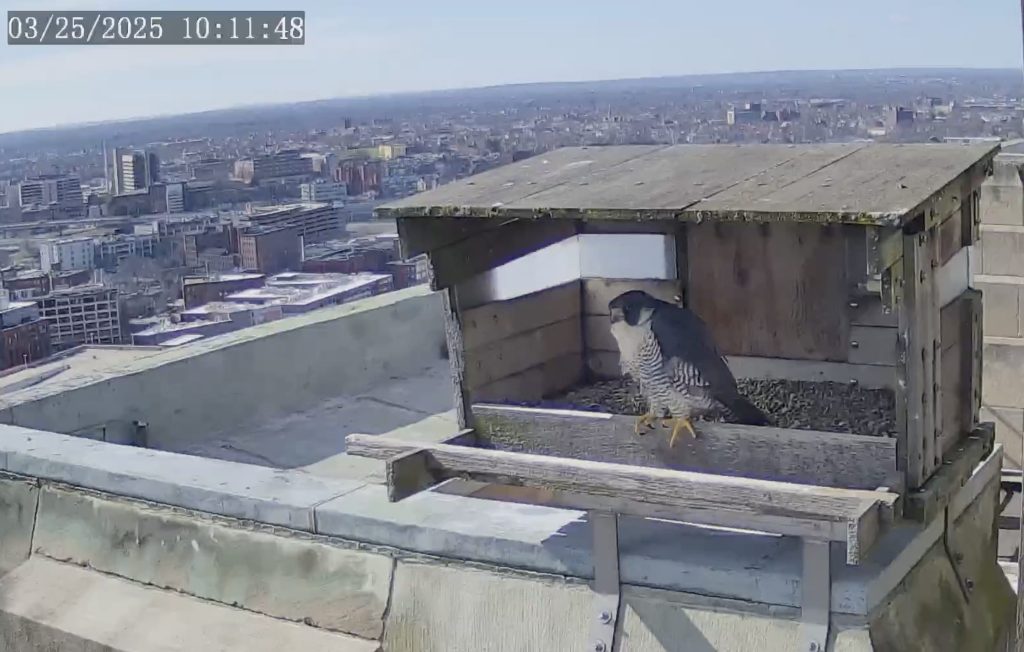
The Audubon Society’s peregrine nesting box is up and running. Courtship began last week and apparently one egg has already been laid. The ASRI posts videos of prior events on the site. For those new to the peregrines, the two adults are hard to tell apart unless they are both in the picture; the larger one is the female.
The box is situated on top of what locals call the Superman Building, located downtown at 111 Westminster Street. Once the eggs have hatched and the parents are busy going back and forth with food, you can look up from the sidewalk below and see them flying around. Look down and you may see the remains of a pigeon carcass; they keep the box pretty neat. I once found the head of a woodcock which I was told was unusual.
Photographer Peter Green of Providence Raptors was very much involved with this nesting box before moving out of the city a few years ago. He has compiled a genealogical chart of the nesting pairs, one of which were a little too closely related (25/AB) but it doesn’t seem to have been a problem. Our most recent pair/s have been unbanded so we’re not sure who they are. Mr. Green still comes up to assist in banding day.
The feed looks nice and clear although those who have been watching the spectacular eagle nest from Big Bear Lake will probably envy some of the production values available there. We have no zoom lens and we have no audio. And we have no real nest, which is how peregrines like it. And our birds never bring home fish.
We also do not name the birds. Unlike the eagles, our birds are banded and can be identified later when they are “found.” This adds to our scientific understanding of the species and the progress of the re-population program. (Frankly, I found many of the comments in the eagle chat box to be unbearably sentimental. One of the three eaglets struggled and did not make it, and they closed the chat box. It was grim but this is nature.)
Mr. Green’s wonderful book has sold out, but he has put it online for all to enjoy. In addition to the peregrines, it features, hawks, owls, eagles (we have eagles too!) and ospreys, as well as the beautiful architecture they have made their own.
*****************************************
From Green’s book:
If you come across a banded falcon, you can submit the information to reportband.gov to learn where it was banded. Some birds are banded as nestlings, and some are netted as juveniles or adults at migration hot spots along the East Coast like the Block Island Bird Banding Station in Rhode Island.