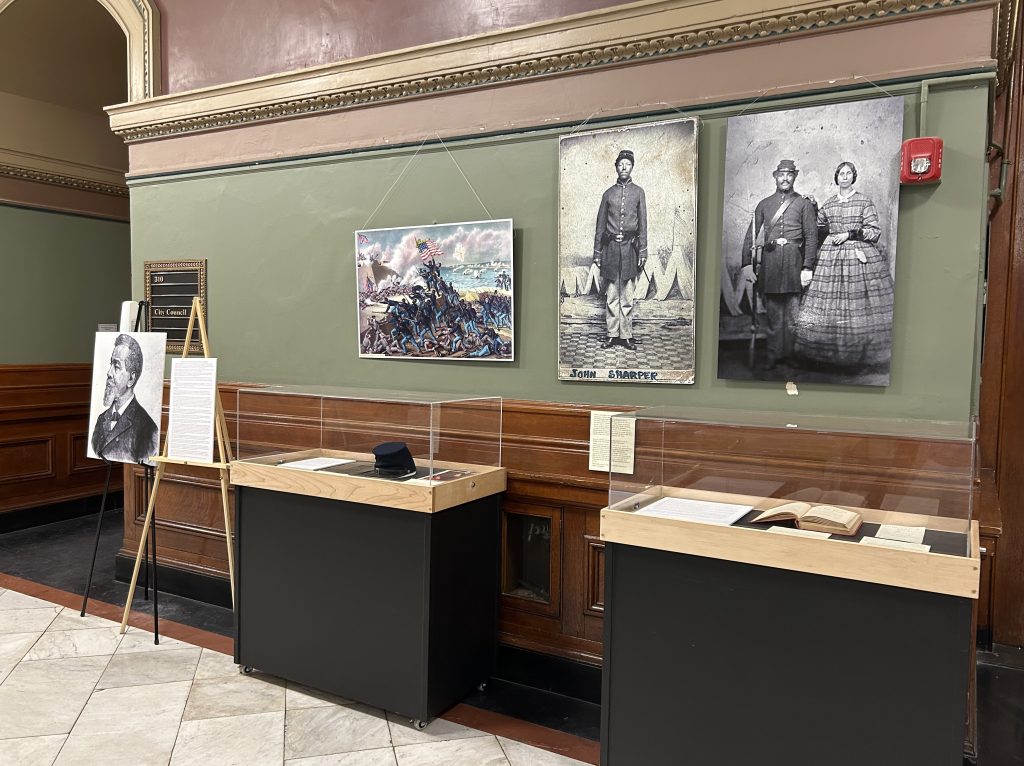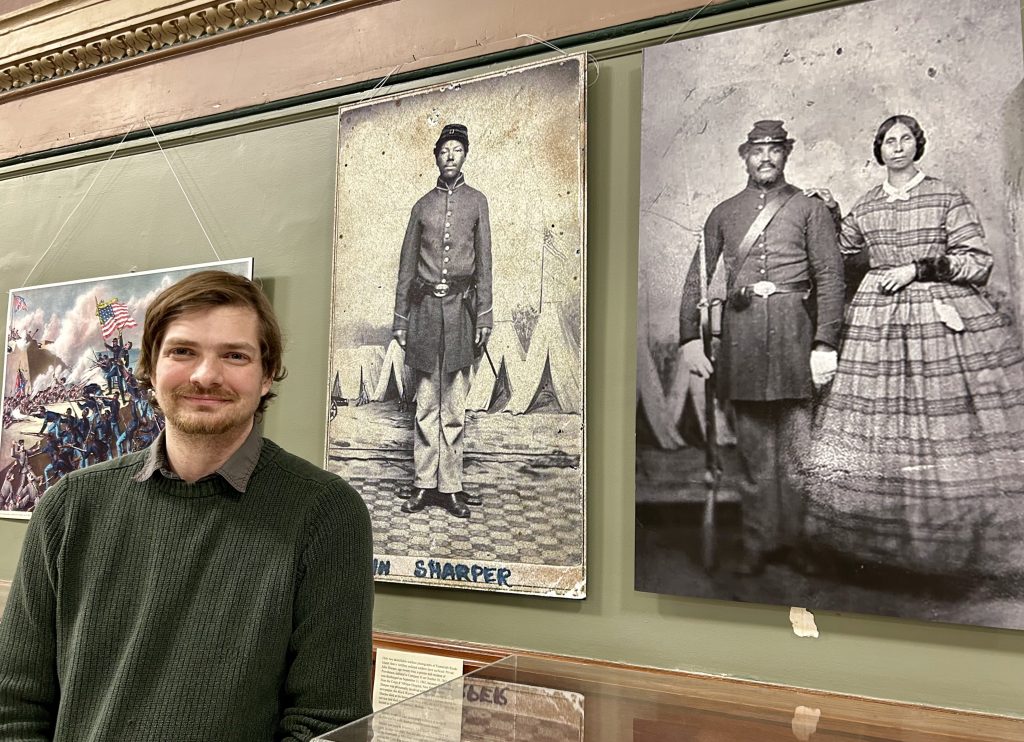
Head over to Providence City Hall for the new exhibit: “This Sacred Charge:” Rhode Island Emancipators of Color on the Battlefield & Homefront, 1775 to 1865. This assemblage of photographs, tintypes, documents, and news items explores the agency of African Americans in their struggle for freedom from the American Revolution until the end of the American Civil War. Seen here is City Archivist Caleb Horton who has been mounting Black History Month exhibits for ten years now. (Horton curated the right side of the exhibit, while the panels on the left are presented by Stages of Freedom which I will write about later.)
Behind Horton are the only two known identifiable wartime photographs of Fourteenth Rhode Island Heavy Artillery enlisted soldiers. On the left is Private John Sharper, aged 22, a printer in Providence. (During the Civil War, volunteer regiments were formed by the states, like the famous 54th Massachusetts. The 14th was the Black regiment in Rhode Island.) On the right is a recently discovered cabinet card featuring Jacob W. Redder and his wife Sophia Mills Redder. At the age of 54, Jacob was older than the average soldier, so he told recruiters he was 39 years old.
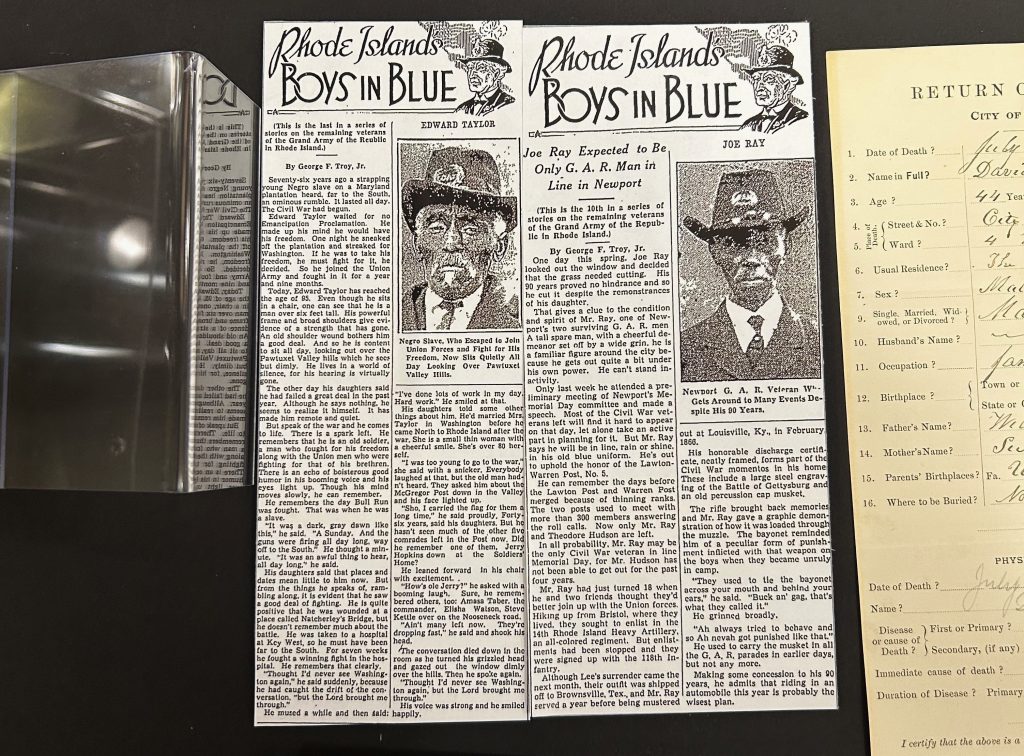
On display in one cabinet are two articles that appeared in the Providence Journal in 1937: Rhode Island’s Boys in Blue which featured interviews with the last surviving African American Civil War veterans (photo below). Both had been part of the regular United States Army. Edward Taylor was 95 and Joe Ray was 90 at the time of these moving profiles. As it happens, the Providence Journal reporter was George F. Troy, Jr., the grandfather of archivist Caleb Troy Horton: “This is kind of an homage and thank you to him.”
A vivid illustration of the 54th Massachusetts’ assault on Fort Wagner, made famous in the movie Glory, is also on display. Horton explained:
The reason we have the 54th on display is because we had three men from Providence that enlisted in the regiment and one of them died at the famous Battle of Fort Wagner. It was a major battle and they took significant casualties and a lot of those men were unceremoniously thrown into a burial pit . . . even Colonel Robert Gould Shaw was left there. His father insisted he remain buried with the men he led.
This event also connects to Christiana Carteaux Bannister. She and her husband, artist Edward Bannister, were ardent abolitionists working and living in Boston at that time. Christiana was appointed president of the Boston Colored Ladies Sanitary Commission, providing domestic aid to Black Civil War soldiers. In May of 1863, just months before Fort Wagner, she and the other women of the commission presented the 54th with their regimental flag at a ceremony, declaring,
The Fifty-Fourth now holds in possession this sacred charge, in performing their duties as citizen soldiers. You will never part with that flag so long as a splinter of the staff or a thread of its web remains within your grasp.
Hence, the name of the exhibit: “This Sacred Charge.”
This Sacred Charge, Providence City Hall, 3rd floor, 25 Dorrance Street, (directions)
***************************
Rhode Island’s Boys in Blue. The last surviving African American Civil War veterans in Rhode Island were interviewed in 1937.
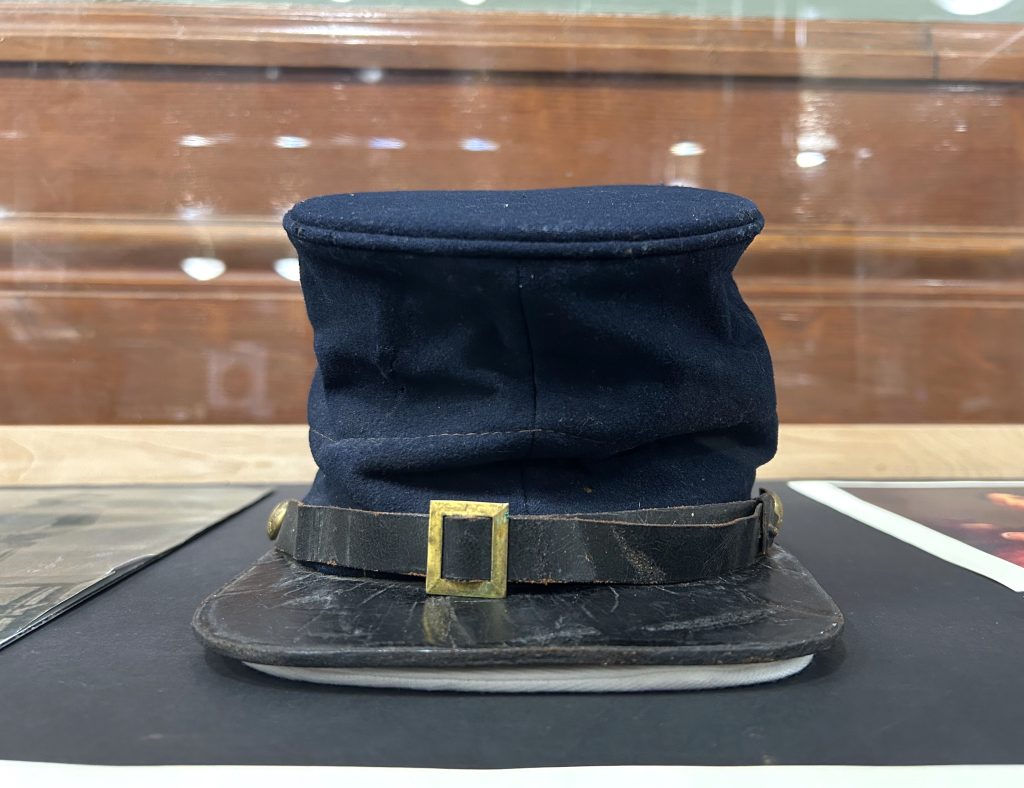
An original Union Army forage cap, courtesy of Patrick Donovan and the Varnum Memorial Armory Museum.
***************************
Caleb Horton has been the city archivist for 11 years. He graduated from URI with a degree in United States history with a concentration in African-American studies as well as a Masters in Library Science. One of his dissertations was on the Black suffrage movement and the Black community in Providence in the 1840s. He started doing these exhibits ten years ago with Councilwoman Mary Kay Harris.
****************************