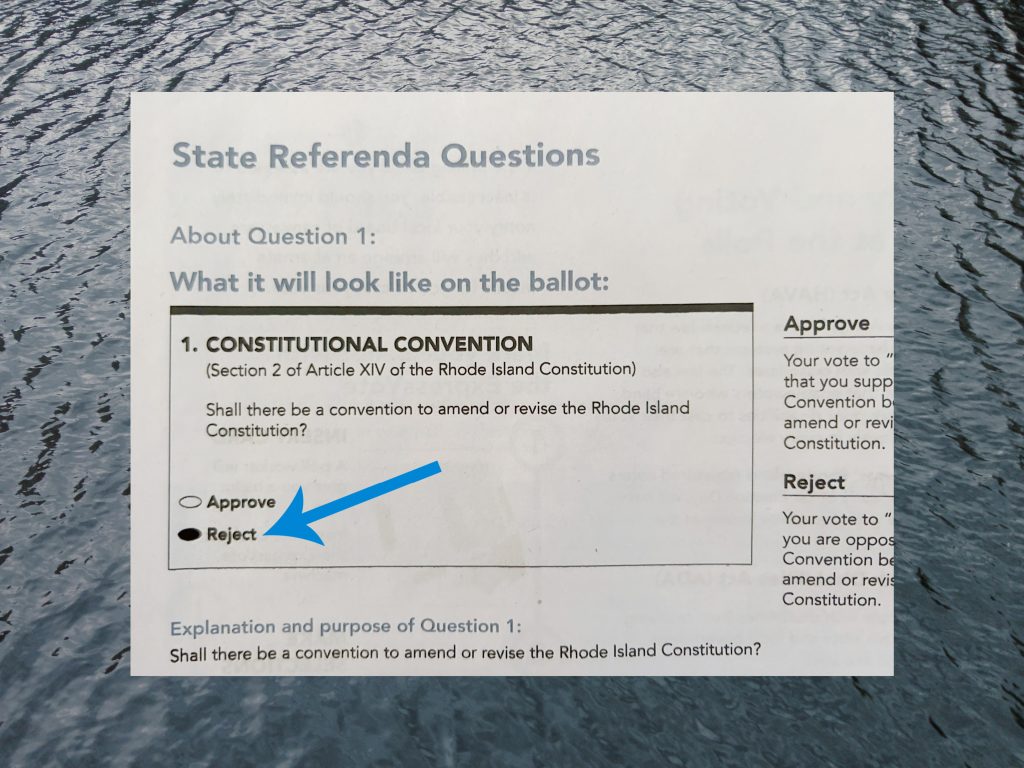
[Update: Good news! Question 1 was rejected by 62% of those voting.] Early voting starts Wednesday and Rhode Islanders are being asked to either reject or approve five referenda questions. We urge you to reject Question 1: “Shall there be a convention to amend or revise the Rhode Island Constitution?” (The other four questions are easily understood bond issues about which you can make up your own minds.) If you are a registered voter, you should have by now received your Voters Information Handbook which you are encouraged to read before heading to the polls.
It seems like it should be a good idea to occasionally revisit and update our state constitution, but trouble could lie ahead given our current intensely polarized political situation. I for one do not wish to have all the anti-choice people pouring in wanting to relitigate the abortion issue. The Rhode Island ACLU also urges a “reject” vote and answers some frequent questions like, “Why would a Constitutional Convention be a threat to civil liberties?”
While a constitutional convention is often billed as an opportunity for voters to have a direct voice in state government, it’s not that simple.
For example, there is no limit to how much money can be spent by special interest groups outside of our state to influence what amendments get put on the ballot, meaning Rhode Islanders don’t actually have total control of what happens. Conventions are also likely to be extremely political, as many of the people who get elected as delegates to the convention have political connections.
They have a great deal of useful information for voters, including why we don’t need to go through this cumbersome process: We already have an effective means of changing governance!
Rhode Island does not need a constitutional convention to change our governance. Constitutional changes on critical issues like separation of powers and voting rights may be done, and have been done in the past, by questions placed on the ballot by the General Assembly.
And they are expensive!
In past years, the bipartisan preparatory commission has estimated the cost to be more than $2 million. That estimate is sure to be significantly higher when the new estimates are prepared for a convention this year. There are much better uses and services where that money could be spent.
The RI Current spoke with John Marion, executive director of Common Cause Rhode Island:
“It’s crazy because conventions used to be really common in the 19th century and even in the first half of the 20th,” John Marion, executive director of Common Cause Rhode Island, said in an interview Monday.
But Marion said constitutional conventions started to fall out of fashion mostly because of political polarization. “That’s led to a real hesitation toward opening up some of our governing documents,” he said.
Should a majority of Rhode Islanders want to move ahead with a convention, Marion said the state would have to set up a special election to select 75 convention delegates to represent each of the state House districts. “If that were to play out this time — a year from now we’d see that election,” he said. “We wouldn’t see a convention until around 2026.”
The Providence Journal ran a primer on how the convention would work if the referendum did pass.
If a majority of voters choose “yes” on Question 1 in November, it will set in motion a process for two more elections.
- First, the General Assembly would have to call for a vote to elect the 75 convention delegates – one for each House district – that would make up the convention. The last time voters called for a convention, in 1984, delegates were chosen in a 1985 special election.
- Then the elected delegates would convene, debate, negotiate and approve a set of amendments to recommend to voters.
- Next, the recommended amendments would be put to voters for final approval, most likely in the next scheduled statewide election. (If the 1986 model holds, an equivalent timeline this decade would be a vote on amendments at the November 2026 general election.)
And by the way, 1984 was all about the abortion issue. The RI Current also spoke with executive director of the RI Chapter of the ACLU, Steven Brown:
“There’s no reason to believe that in light of the polarized climate we live in today that similar types of ideologically charged issues will not come out of a convention,” Brown said. “There’s this very utopian view of citizens meeting and coming up with grand ideas, but a constitutional convention is just as political as the General Assembly — if not more so.”
The “right to life” amendment cleared the convention, but was defeated at the ballot box, with 66% of voters choosing to reject it.
From the ProJo (10.8.24) Governor McKee agrees. His spokeswoman issued this statement: “The potential of outside interests upending these hard-won rights in Rhode Island is too great for the Governor to support Question 1.”
Also opposed: Lt. Governor Sabina Matos; Secretary of State Greg Amore; Senate President Dominic Ruggerio; House Speaker Joseph Shekarchi; and Planned Parenthood.
We do not need this, especially not now! Only five states even have this mechanism.
REJECT QUESTION ONE!
(Go here to download your own Voter Information Handbook.)